
Workplace Training for the Modern Era: How your organization can transition to blended learning
As the modern workplace rapidly shifts and technology evolves, traditional approaches to employee training are being continuously redefined. While organizations recognize the urgent need to elevate their workforce capabilities, many legacy training programs struggle to deliver engaging, flexible, and scalable learning experiences. To bridge critical skill gaps and meet modern learner expectations, forward-thinking organizations are increasingly turning to a strategic framework: blended learning.
If you have been looking for ways to modernize your organizational learning, you are likely becoming familiar with the term blended learning (also known as hybrid learning). At its core, blended learning is an approach to workplace training that combines Instructor-Led Training (ILT), eLearning, mobile learning, On-The-Job (OJT) training, and immersive learning elements. A learning program is formally considered blended whenever it strategically integrates two or more of these delivery formats.
Rather than relying on a single, rigid training method, blended learning adds an essential layer of knowledge to accommodate modern learner expectations.
There are several common misconceptions about what blended learning actually entails. Some assume it simply means hosting a standard classroom lecture followed by an online reading module, or asking participants to answer a live quiz on their smart devices during a session. While those are valid educational techniques, true digital transformation of workforce training requires a far more strategic approach.
In a nutshell, blended learning uses a mix of online and offline activities to cover different aspects of the same training topic, supplemented by continuous performance support tools. This combination affords organizations uninterrupted training that balances human interaction with self-paced flexibility, saving both the time and costs traditionally associated with legacy programs.
Harnessing the full potential of blended learning involves matching the right delivery format to your specific performance objectives. Blended learning formats span a broad spectrum of options:
As shown in the ecosystem diagram below, effective blended learning balances two critical halves: versatile instructional formats and the robust technology infrastructure required to support them.
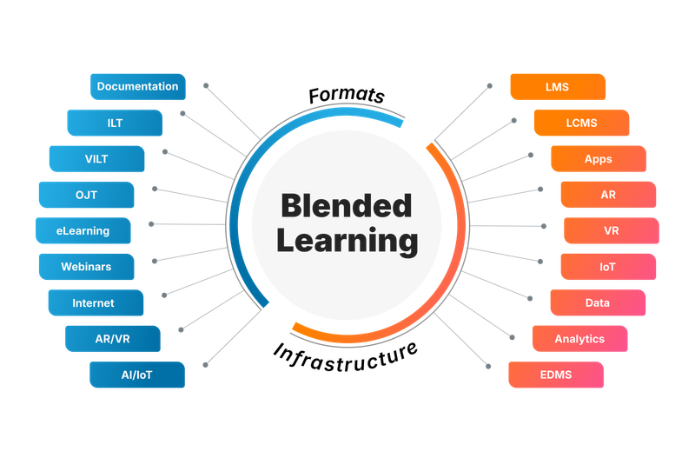
ILT: Instructor-led Training
VILT: Virtual Instructor-led Training
OJT: On-the-Job Training
AI: Artificial Intelligence
AR: Augmented Reality
VR: Virtual Reality
IoT: Internet of Things
LMS: Learning Management Systems
LCMS: Learning Content Management System
EDMS: Electronic Doc. Management System
Adopting a holistic blended learning strategy delivers tangible advantages for organizational growth and employee performance:
To successfully transition your organization toward a blended learning environment, keep these three foundational building blocks in mind:
As workplace demands continue to shift, establishing an agile, modern learning strategy is essential to building the workforce of tomorrow. Taking a proactive approach to blending your training experiences creates a win-win environment where both your employees and your organization thrive.
Ready to elevate your workplace learning strategy? Connect with one of our digital knowledge solution experts today to explore customized blended learning frameworks tailored to your goals.